One Runner's Routine Isn't Everyone's Running Prescription
Stiffness, stability and flexibility are often discussed as though they are competing qualities. But what does the science actually tell us, and should recreational runners be taking advice from elite athletes at face value?

I recently watched a podcast interview with an elite distance runner who explained that he doesn't stretch. His reasoning was that, as a long-distance runner, he wants to remain "tight" to maintain stability when running. If you guessed the podcast then comment below!
At first, I understood where the argument was coming from despite this not being advice that I follow or recommend! Running is a repetitive, high-load activity, and the ability of our muscles and tendons to produce, absorb and transfer force efficiently is fundamental to performance.
But it also made me question something.
Are we beginning to confuse stiffness with stability? And, more importantly, what happens when a statement made by an elite athlete becomes general advice for thousands of recreational runners?
There is some interesting biomechanics behind the idea of staying stiff. However, I think we need to look beyond the soundbite.
First, what do we actually mean by staying tight?
The words tight, stiff, strong and stable are frequently used interchangeably in conversations about exercise. Physiologically, however, they describe very different things.
Let's distinguish between four concepts:
Flexibility: The ability of a muscle or muscle-tendon unit to lengthen, contributing to the available range of motion.
Mobility: The ability to actively move a joint through its available range of motion.
Stiffness: The resistance of a structure to deformation when a force is applied.
Stability: The ability to maintain or control a joint or body segment during movement, despite external forces.
These qualities interact, but they are not interchangeable.
A runner can have good flexibility and excellent joint stability. Equally, someone can have considerable muscular stiffness but poor strength, coordination and movement control.
This distinction matters because being stiff does not automatically make someone stable. I have seen it all on my treatment table!
Why stiffness actually matters in running
There is a legitimate physiological argument behind the idea of maintaining stiffness during running.
Running involves a mechanism known as the stretch-shortening cycle (SSC).


During the stance phase of running, the lower limb experiences loading as the foot makes contact with the ground. Muscles and tendons absorb and manage this force before contributing to propulsion.
The muscle-tendon units undergo a combination of lengthening and shortening, allowing elastic energy to be stored and subsequently returned.
The Achilles tendon is a particularly important example. It can store and release elastic energy during running, helping contribute to propulsion and running efficiency.
This is where muscle-tendon stiffness becomes relevant.
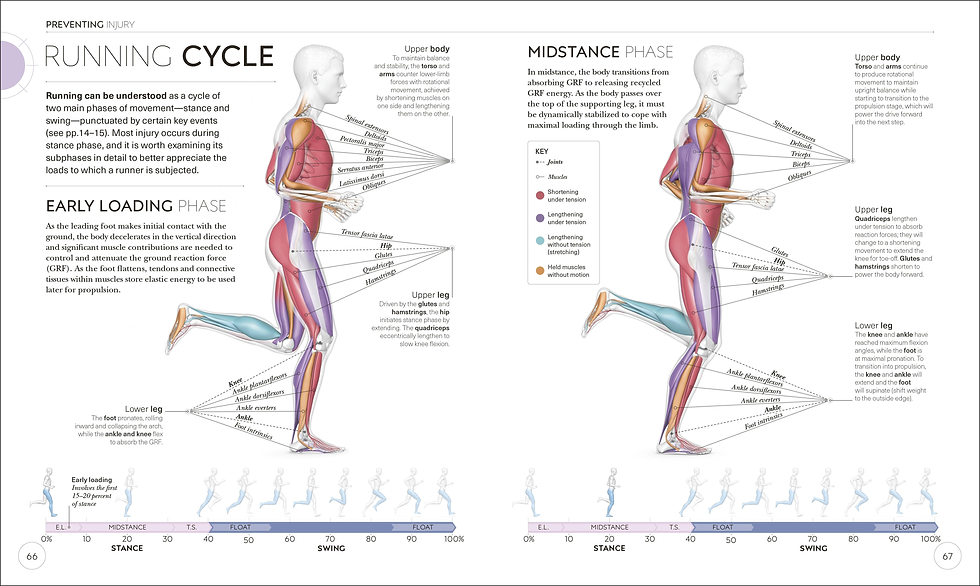
Appropriate stiffness can help structures resist deformation and transmit force efficiently. It is one of several mechanical properties that contribute to running performance. However, there is an important distinction between the stiffness of a muscle-tendon unit and the flexibility of an individual muscle. We cannot simply assume that reducing muscle stiffness through stretching will negatively affect running performance.
In fact, a 2025 systematic review and meta-analysis by Warneke et al. investigated the acute and chronic effects of stretching on running economy. The review included 15 studies and 181 participants. The researchers found no statistically significant effect of stretching on running economy in the acute studies, regardless of whether static, dynamic or proprioceptive neuromuscular facilitation stretching was used.
The researchers did acknowledge that the evidence was of low certainty, with limited long-term research available.
Nevertheless, their findings challenge the assumption that stretching should automatically be avoided because it reduces the stiffness required for efficient running.
In other words, the biomechanics are more complicated than simply staying tight.
Stability isn't just about stiffness
This is probably the part of the conversation I find most interesting.
If the argument for avoiding stretching is to maintain stability, we need to consider what actually provides stability to our joints. Joint stability is not the responsibility of one structure. It is the result of several systems working together.
1. The muscular system
Muscles provide dynamic stability.
Through coordinated contraction, muscles control joint movement, regulate force and help maintain appropriate positioning during activity.
For runners, this includes the quadriceps, hamstrings, gluteal muscles, calf complex and the smaller muscles responsible for controlling the foot and ankle.
Strength, endurance and neuromuscular coordination all contribute to this process.
2. The passive structures
Ligaments and joint capsules provide passive support.
Ligaments connect bone to bone and help resist excessive movement beyond the physiological limits of a joint. They also contain sensory receptors that contribute to proprioception, helping the nervous system understand joint position and movement.
However, ligaments are not a substitute for muscular control. They work alongside the active muscular system.
3. The nervous system
The nervous system coordinates muscular activity using sensory information from muscles, tendons, ligaments and other tissues. This allows us to respond to changing forces, maintain balance and make continuous adjustments during movement.
Joint stability is therefore a combination of passive restraint, muscular capacity and neuromuscular control.
It is not simply a case of keeping muscles tight.
And this is where I think the argument needs challenging: if we want runners to become more stable, shouldn't we be focusing on developing their strength and movement control rather than encouraging them to avoid flexibility work?
Does stretching actually increase injury risk?
Now, I want to be careful here.
I am not suggesting that every runner needs to stretch, or that not stretching automatically increases their risk of injury.
In fact, the evidence does not support either of those blanket statements.
Stretching has a well-established role in improving range of motion. However, its effectiveness as a general injury-prevention strategy is considerably less convincing.
Lauersen et al. (2014) conducted a systematic review and meta-analysis examining exercise interventions for sports injury prevention. Across 25 trials involving 26,610 participants, stretching alone did not demonstrate a statistically significant reduction in injury risk.
Strength training, on the other hand, showed a much more favourable association with injury prevention.
More recently, Warneke et al. (2025) published an international Delphi consensus statement examining the practical applications of stretching. The panel concluded that stretching should not be considered an all-encompassing injury-prevention strategy. They also highlighted its effectiveness in improving range of motion.
So, where does that leave us?
It means that stretching is not a magic solution to injury prevention, but neither is avoiding it a proven way of protecting ourselves.
For an individual with restricted ankle dorsiflexion, for example, improving available range of motion may be useful if that restriction affects their ability to perform a particular movement. I have a client with very limited dorsiflexion as a result from a previous footballing career which ended in multible ankle sprains. This client now suffers with chronic and reocurring planta fascitis. Stretching is a must!
For someone else, targeted strength training or improvements in movement control may be more appropriate. A person with hyper joint mobility, for example, will benefit more from calf, glute, hamstring and hip strengthing training to almost make up for the extra pressure put on the muscles from the increased travel of the joints.
The intervention should address the individual's needs rather than follow a universal rule.
What about stretching before running?
It is also worth distinguishing between different types of stretching.
Static stretching involves holding a muscle in a lengthened position, whereas dynamic stretching involves actively moving through a range of motion. Prolonged static stretching immediately before maximal or explosive activity can temporarily reduce force production and performance.
This is particularly relevant to sprinting, jumping and activities requiring maximal power.
However, this does not mean all stretching is detrimental before exercise.
A dynamic warm-up, involving controlled movements and gradually increasing activity, can help prepare the body for the demands of running.
Shorter static stretches may also have a place depending on the individual and the purpose of the warm-up. The 2025 consensus statement by Warneke et al. reinforces the importance of understanding the intended application of stretching rather than treating all stretching techniques as the same intervention.
The question should not simply be whether we stretch before running, but why we are doing it and whether it is appropriate for the activity ahead.
An elite athlete's experience is not a universal recommendation
This brings me back to the original podcast.
An elite distance runner may have spent years developing their muscular strength, tendon capacity, running mechanics and neuromuscular coordination. Their training programme will be designed around their individual requirements, performance goals and physical adaptations.
They may have excellent functional range of motion without needing additional stretching.
And that is absolutely fine.
But consider someone who has recently taken up running.
Perhaps they work at a desk, have limited ankle mobility, reduced calf strength or a history of musculoskeletal problems.
Their physical requirements may be very different.
The fact that an elite athlete doesn't stretch does not mean that a recreational runner should follow the same approach.
There is a difference between saying:
"I don't stretch because I don't feel I need to for my running performance."
And saying:
"Runners shouldn't stretch because they need to remain tight for stability."
The first is an individual's training preference. The second is a physiological recommendation that requires evidence.
We need to be mindful of how easily personal experiences become generalised advice, particularly when they are shared with large audiences.
So, what should runners actually be doing?
Rather than debating whether stretching is good or bad, I would much rather see runners focus on developing a musculoskeletal system capable of tolerating the demands of running.
For most recreational runners, this means considering several things:
1. Progressive strength training
Developing muscular strength and capacity is important for producing and controlling force. Exercises targeting the hips, quadriceps, hamstrings and calf complex can form part of a well-rounded programme.
2. Appropriate mobility work
If a restriction in range of motion affects your movement, comfort or ability to perform an activity, targeted mobility or flexibility work may be useful.
3. Dynamic preparation
Gradually increasing movement intensity before running can help prepare the body for the activity ahead.
4. Training load management
Increasing running distance, frequency and intensity too quickly can exceed an individual's current capacity. Stretching cannot compensate for inadequate recovery or poorly managed training progression.
5. Individual assessment
Not every runner has the same movement requirements. Training should consider their physical capacity, injury history, goals and any identifiable restrictions.
My final thoughts: perhaps we need to stop looking for rules
I don't disagree with the idea that stiffness has an important role in running biomechanics. It absolutely does.
What I question is the suggestion that avoiding stretching is necessary to maintain that stiffness, or that doing so is automatically beneficial for stability. The human body is considerably more complicated than that.
Muscles, tendons, ligaments and the nervous system all contribute to movement and stability. Their roles overlap, interact and adapt to the demands we place on them. Stretching can improve range of motion, but it is not a replacement for strength training. Equally, stiffness can contribute to running performance, but it should not be confused with a lack of flexibility.
Perhaps the bigger issue is how readily we accept advice from high-profile athletes without considering whether the evidence supports it or whether it applies to us.
An elite athlete's experience is valuable, but it is not automatically a prescription for everyone else.
So, should runners stretch?
My answer would be: if there is a reason to, absolutely. If there isn't, you don't necessarily need to. But don't avoid it simply because somebody told you that being tight makes you a better runner.
After all, good sports science isn't about following rules. It's about understanding why we do what we do.
And that's what I think we should keep talking about.
References
Lauersen, J.B., Bertelsen, D.M. and Andersen, L.B. (2014) 'The effectiveness of exercise interventions to prevent sports injuries: a systematic review and meta-analysis of randomised controlled trials', British Journal of Sports Medicine, 48(11), pp. 871–877. https://doi.org/10.1136/bjsports-2013-092538
Warneke, K., Zechner, M., Siegel, S.D., Jochum, D., Brunssen, L. and Konrad, A. (2025) 'Acute and Chronic Effects of Stretching on Running Economy: A Systematic Review with Meta-Analysis', Sports Medicine - Open, 11, 61. https://doi.org/10.1186/s40798-025-00859-0
Warneke, K. et al. (2025) 'Practical recommendations on stretching exercise: A Delphi consensus statement of international research experts', Journal of Sport and Health Science, 14, 101067. https://doi.org/10.1016/j.jshs.2025.101067

Comments